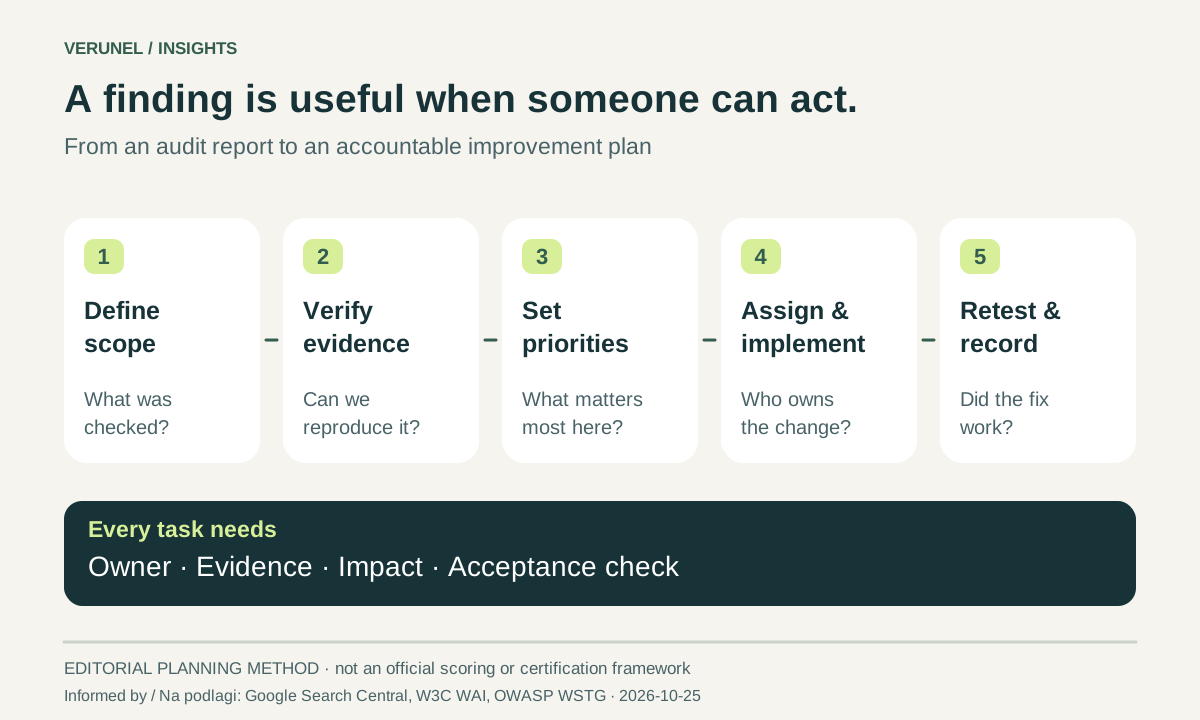
A long report is not the same as a plan. A website audit may flag missing metadata, awkward forms, slow templates, and technical configuration concerns. If every item is marked urgent, the owner has gained a new inbox rather than a clear decision.
A useful roadmap answers four questions: What is happening? Why does it matter here? Who will act? How will we know the change worked? The method below is an editorial planning framework, informed by official guidance, not an official Google or OWASP scoring system.
Start by stating the scope
List the domain, URLs, date, device conditions, and checks performed. Identify exclusions, such as authenticated areas, payment flows, source-code review, or testing with assistive technology. Do not imply those activities happened if the audit did not include them.
This matters when reading a sample. Ten URLs may reveal a recurring template problem, but a sample cannot establish that every page behaves identically. Mark the difference between “observed on these pages” and “suspected across this template”. The first is evidence; the second is a hypothesis to confirm.
Keep a short coverage note beside the summary. Readers should not need to search the final page to understand what the report can and cannot support.
Turn observations into useful tickets
A ticket called “Improve SEO” gives nobody a finish line. A better ticket identifies the affected pages, the current behaviour, the supporting evidence, and a proposed acceptance check.
For example: “Review the title and main heading on the service-page template; make each accurately describe that page’s offer.” This is an illustrative task, not a detected issue on your site. Google’s SEO Starter Guide emphasises useful content and clear information, while making no promise that a particular change will deliver first place. Google Search Central: SEO Starter Guide
Keep evidence and recommendation separate. A missing title can be observed. The best replacement still needs knowledge of the service and its audience.
Investigate indexing controls before changing them
An indexing issue can deserve early attention when a public, business-critical page is unintentionally excluded. But do not remove every restriction just because a checker notices it: an account area or internal result page may be excluded intentionally.
Google distinguishes crawl controls from indexing controls. A robots.txt rule is not a reliable way to prevent a URL appearing in search results. A noindex directive can prevent indexing, but Google must be able to crawl the page to see it. Google: robots.txt, Google: noindex
The task is therefore to confirm intent first, then implement and verify the correct control. “Remove warning” is not an adequate acceptance criterion.
Confidential content needs access controls; robots.txt and noindex are not substitutes.
Prioritise consequences, not the number of warnings
Start with issues that block an essential task, affect many relevant pages, or require urgent specialist assessment. Next consider well-evidenced improvements with manageable effort. Put speculative refinements behind confirmed problems unless there is a clear reason to investigate them sooner.
A practical discussion can use four fields: impact, reach, confidence, and effort. Avoid pretending that multiplying subjective ratings produces an objective financial forecast. Explain the judgement in a sentence, especially when a small but serious issue takes priority over a large collection of cosmetic warnings.
Dependencies also matter. Fixing a shared component may be more efficient than editing each affected page separately. Conversely, a broad redesign may be unnecessary when one reproducible defect explains the problem.
Keep usability and security claims proportionate
A page can pass a basic check and remain difficult to use. W3C presents its Easy Checks as an initial review, not a comprehensive accessibility assessment. Treat broader manual and user testing as separate work when required. W3C WAI: Easy Checks
Apply the same discipline to security. An external technical review is not a penetration test, and an absence of visible warnings is not proof of safety. OWASP’s Web Security Testing Guide explains that tools do not provide a complete solution and that security requires a broader process. OWASP WSTG v4.2: testing principles
Escalate suspicious findings for qualified investigation. Agree the scope and authorisation before active security testing. Do not turn an uncertain observation into a public claim that a site is vulnerable—or certified secure.
Close the loop with verification
Assign an owner and an acceptance check before implementation. Retest the affected pages and a representative neighbouring journey after the change. Keep the before-and-after evidence, including any remaining uncertainty.
An executive summary should explain priorities and decisions. A developer report should preserve reproducible detail. Neither should promise a ranking increase, a conversion uplift, or complete security simply because the checklist is shorter.
Start with Verunel’s €39 one-off full website audit, excluding VAT: one domain, up to 10 URLs, an AI summary, a PDF and share link, plus executive and developer reports. Use it as the foundation for an owned, prioritised improvement plan—not as a security certification or a substitute for specialist testing.
Audit coverage: deeper browser checks apply to the entry page; additional URLs receive technical HTTP and content review.
Sources and review date
Official sources checked on 25 October 2026: